The Workaround
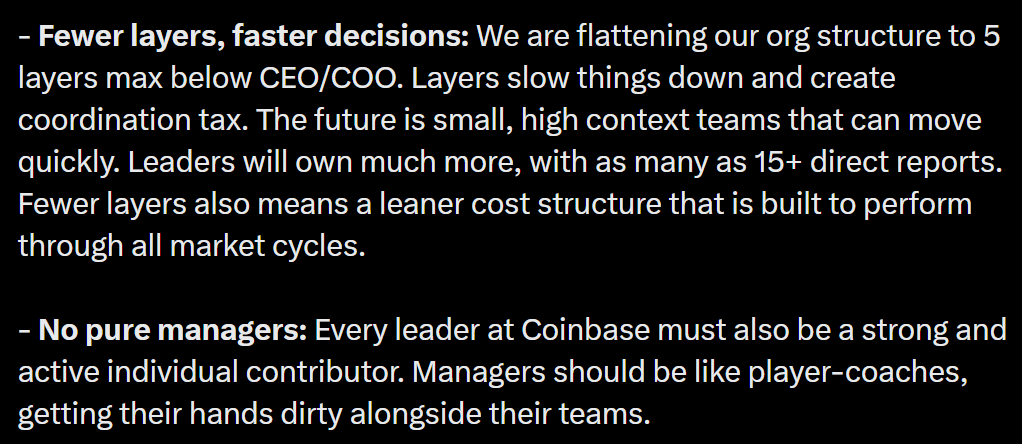
Brian Armstrong's email to Coinbase employees declared the end of the pure manager. He's right. But the pure manager wasn't killed by AI - it was always a workaround.
Management has always had two jobs. The first is people overhead: 1:1s, performance reviews, PIPs, managing people out. The second is direction: understanding a problem deeply enough to decide what gets done, in what order and why.
Some managers did both. Many - especially at scale - mostly did the first. That's the pure manager.
Here's the thing. The manager existed to solve a real coordination problem: how does one person's intent become many people's action? The answer was hierarchy - a chain of human intermediaries who translated, delegated and tracked. Each link added some value (hopefully) and always added noise (inevitably).
That wasn't a design choice. It was a constraint. There was no other way.
Natural language AI means you can now communicate intent directly to execution, at whatever scale you need, without the degradation. The chain of human intermediaries was never the goal - it was the workaround. The workaround now has a better alternative.
So the question every manager should be asking is: what am I actually adding to this chain?
If the honest answer is "I translate intent into instructions and track whether they happened" - that's the workaround function. That's what's gone.
If the answer is "I bring domain knowledge and judgment that the person above me doesn't have" - that's real value. But it also makes you a domain expert, not a manager in the traditional sense.
In an AI-native org, individual contributors are already directing agents. If a pure manager still sits above them, you've got manager, IC, agent - the manager's intent travels through a human before it reaches anything. Why tell a person to tell their AI to do something, when you can just tell the AI yourself?
And it's not just pure managers who need to reckon with this.
Years spent mostly on people overhead means years not building the domain knowledge you'd need to direct work effectively - human or AI. The further you abstracted yourself from the work in pursuit of seniority, the less leverage you have in what comes next.
But the flip side is equally real, and talked about less. Sharp, reliable individual contributors who've always relied on someone else to set direction face the same reckoning. AI commoditises execution. Doing the work well is table stakes now, not differentiation. The people who thrive were always thinking one level above their immediate work - about what should get done, not just how.
Both ends compress toward the same middle: people who are genuinely close to the work, with real domain depth, who can set direction and close the loop themselves.
Next week: if the pure manager is gone and the pure IC is squeezed, what does the winning shape actually look like? It's not a new kind of manager.