Execution Was Never the Moat
Execution was never the moat. It only looked like one for twenty years because it was expensive.
The oldest idea in strategy is choosing what not to do. Be genuinely great at a few things, competent at everything else and don't waste your best people gold-plating the parts nobody picks you for.
Good advice. The second half almost never happened.
"Competent at everything else" was never free. It meant knowing what the best shops in the world had converged on, then finding someone good enough to build it. That knowledge was expensive and the people who had it were always pulled onto the stuff that mattered or onto firefighting. So the baseline, all the supporting machinery that isn't your edge, was a swamp. Half-finished auth. Bespoke caching one bloke wrote in 2019 that only he understands. Observability you keep meaning to do properly. Every company carries a long tail of "good enough for now", because parity was never cheap.
That's the part that's changed. Driven well, a model now builds the genuinely best-practice version of almost any of that machinery. Tell it to read the reference architectures and the best writing on the problem and your own conventions before it designs anything. What comes back beats most of your engineers. The default output is slop. Driven properly it's better than your team and the only variable is whether you bothered to make it research before it built.
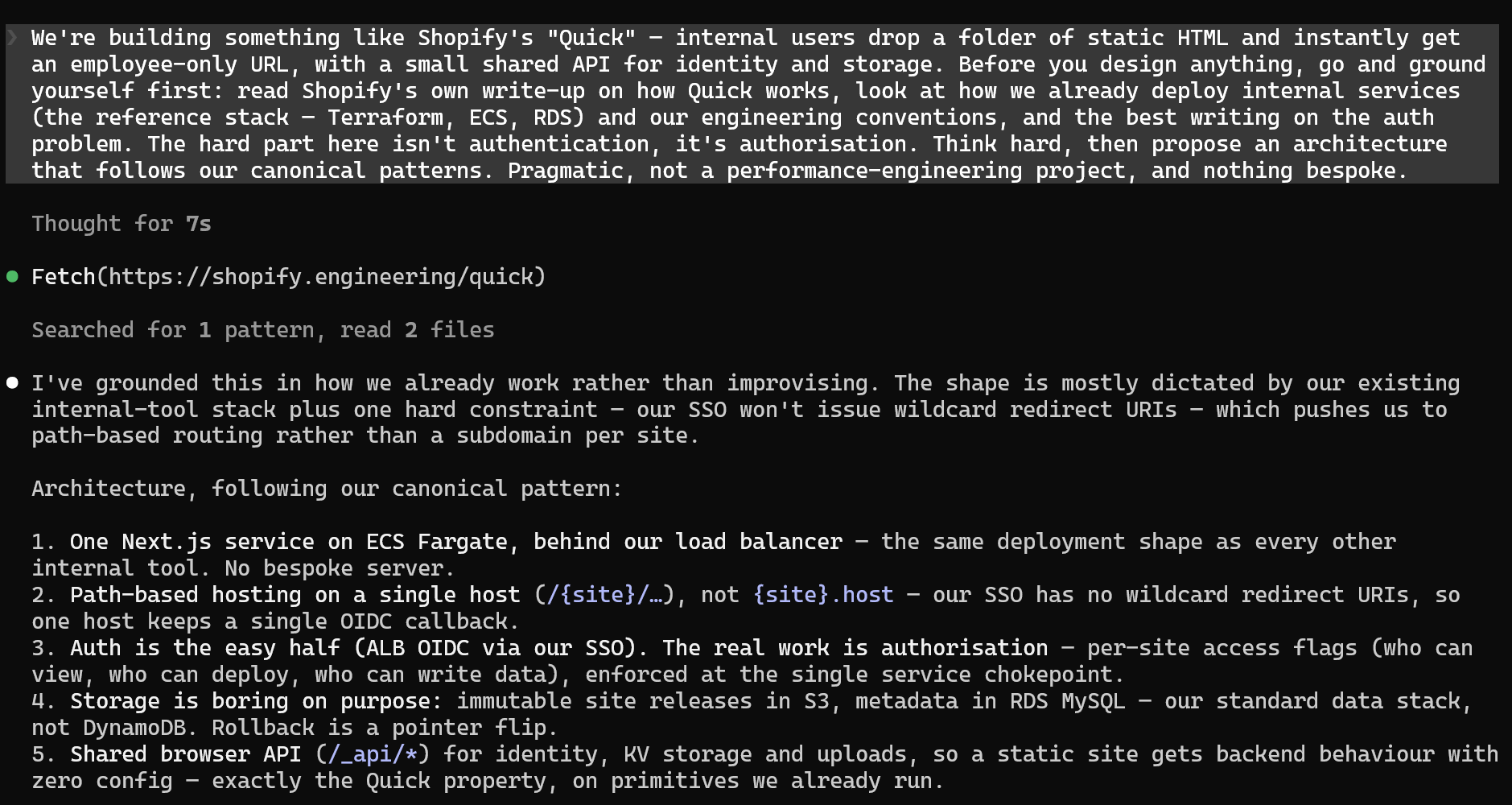
And it has no ego. Show a human engineer a better approach than the framework they built last year and you're in a negotiation. Show the model and it bins its own design on the spot, no sunk cost.
It's also stronger on the canonical pattern than on your clever in-house one, because the canonical pattern is all over its training data and your bespoke abstraction is in nobody's. So the cleverness your team is proud of is now a tax. The model's never seen it, you re-teach it every session and it still follows it worse than the boring standard. The gravity pulls towards convention now and it pulls hard.
So the baseline moved up. Not for you - for everyone. The backlog that used to cost a quarter and an expensive hire is now a couple of well-driven afternoons. Even the president drinks the same LLM.
Which sounds like good news until you finish the thought. If everyone can reach parity cheaply, parity stops being worth anything. It was never the prize. It was the toll you paid to reach the bit that's actually yours. When the toll was expensive, paying it well looked like an achievement. Now it's free. Life didn't get easier - it just got easier to be average and harder to be exceptional.
So you're back at the oldest question in strategy, just louder: which few things are you going to be great at? A model will hand you a best-practice version of everything else but it can't tell you which things those should be. That judgement still isn't in any training set, and we're about to find out who actually had a few worth doing well.